
Introduction
BPC 157 is one of the most talked-about research peptides in wellness, sports recovery, and regenerative medicine discussions. It is often promoted online for tendon healing, muscle repair, gut protection, inflammation control, and faster recovery after injury. But popularity is not the same as medical proof. The important question is not only “Can BPC 157 help tissue repair?” The better question is: “What does the evidence actually show in humans?” Right now, BPC 157 is best understood as an experimental peptide with interesting laboratory and animal data, but limited high-quality human evidence and no established approval as a routine medical treatment. This article explains what BPC 157 is, where it comes from, how it may work, what it is being studied for, why its approval status matters, and what is still uncertain.




- BPC 157 is popular, but popularity is not medical proof.
- It remains experimental, with limited high-quality human evidence.
- The key question is what human studies actually show.
What Is BCP 157?
BPC 157 stands for Body Protection Compound 157. It is a peptide (a short chain of amino acids, which are the building blocks of proteins). More specifically, it is a pentadecapeptide (a peptide made of 15 amino acids). BPC 157 is usually described as a synthetic research peptide (a laboratory-made peptide used mainly for scientific study). It is modeled from a peptide sequence associated with protective proteins found in gastric juice (fluid produced in the stomach). Because of this stomach-related origin, it is often called a stable gastric pentadecapeptide (a stomach-derived 15-amino-acid peptide that appears more resistant to breakdown than many other peptides). It is not the same as a vitamin, mineral, ordinary supplement, or approved prescription medicine. It is being studied as a potential biologic-like therapeutic compound (a treatment inspired by biological molecules), mainly because it may influence tissue repair, inflammation, blood vessel function, and wound healing pathways.
How Is It Derived or Made?
BPC 157 is inspired by a biological sequence linked to protective substances in human gastric juice. However, the BPC 157 used in research is generally synthetically produced (made in a laboratory rather than extracted directly from the human body). A common laboratory method for producing peptides is solid-phase peptide synthesis (a process where amino acids are added one by one onto a support material until the full peptide chain is built). After the chain is made, it must be purified to remove incomplete or unwanted peptide fragments. This matters because small differences in manufacturing quality can affect purity, safety, and biological behaviour. In regulated drug development, peptide manufacturing must follow strict quality standards. In unregulated markets, the real contents, purity, sterility, and stability of peptide preparations may be uncertain. This is one reason why regulators have raised concerns about compounded or non-approved BPC 157 preparations.
How Does It Work?
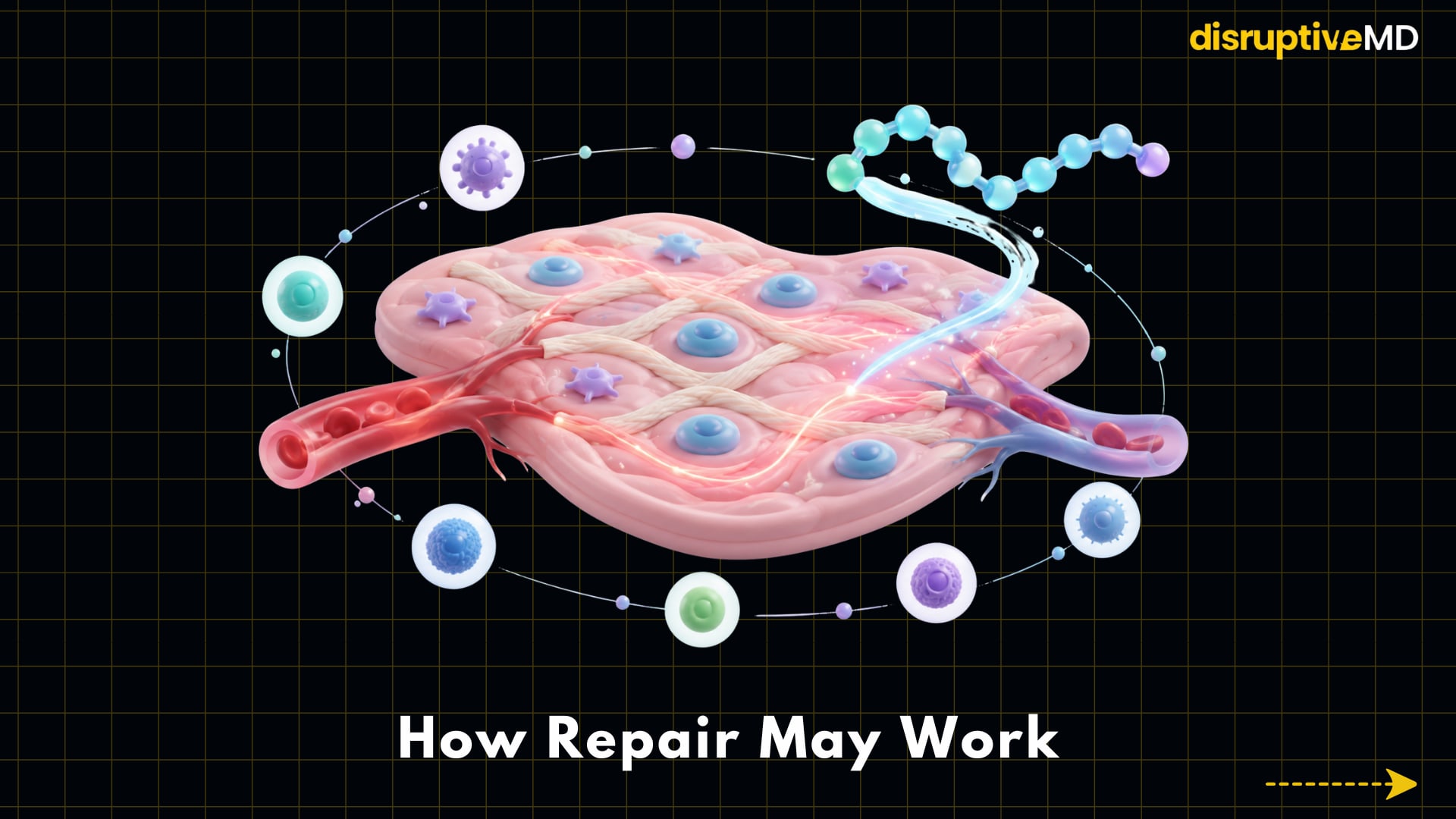
The exact mechanism of action (how a substance produces effects in the body) of BPC 157 is not fully established in humans. Most of what is known comes from laboratory and animal research. Preclinical studies suggest that BPC 157 may affect several biological processes involved in healing. These include angiogenesis (formation of new blood vessels), collagen synthesis (production of collagen, a structural protein important for skin, tendon, ligament, and wound repair), fibroblast activity (activity of repair cells that help build connective tissue), and nitric oxide signalling (a pathway involved in blood vessel tone, inflammation, and tissue protection). A simple way to understand the proposed mechanism is this: injury repair needs blood flow, immune balance, structural rebuilding, and coordinated cell movement. BPC 157 appears to interact with some of these repair-related pathways in animal and cell studies. That does not automatically mean it works the same way in humans. This distinction is important. A compound can look promising in cells or animals but fail to show clear benefit, safe dosing, or meaningful outcomes in human clinical trials.
What Is It Used For?
BPC 157 has no clearly established approved medical use as a standard human treatment. Its proposed or studied uses can be separated into several categories. Research-stage uses: BPC 157 has been studied in animal models for tendon injury, ligament injury, muscle injury, wound healing, gastrointestinal injury, nerve injury, and tissue protection. These are mostly preclinical studies (research done in cells or animals before strong human testing). Early human research: Small human reports have explored areas such as chronic knee pain, bladder pain symptoms, and intravenous safety. These studies are small and not enough to prove that BPC 157 is effective or safe for routine medical use. Popular but unproven uses: Online and wellness discussions often mention BPC 157 for sports recovery, tendon repair, gut health, joint pain, inflammation, anti-aging, and performance. These uses remain unproven unless supported by well-designed human clinical trials. Approved medical uses: Reliable evidence of approval for BPC 157 as a medicine for a specific human disease was not found in major regulatory information reviewed for this article.
Is It Approved for Human Use?
BPC 157 should be considered investigational (still being studied and not established as an approved routine treatment). A major drug regulatory authority has stated that compounded drugs containing BPC 157 may present safety risks, including possible immunogenicity (the ability to trigger an immune response) and concerns related to peptide impurities and characterization. The same regulatory source states that it has limited safety-related information for proposed routes of administration and lacks enough information to know whether such products would cause harm in humans. A public safety resource also states that BPC 157 is not a dietary ingredient, is an unapproved drug, and is not included in an approved-drug database under BPC 157 or other listed names. There are clinical trial registry entries related to BPC 157. One earlier Phase 1 trial was listed for safety and pharmacokinetics (how the body absorbs, distributes, metabolizes, and clears a substance), but published results are not clearly available. A newer Phase 2 trial has been listed to study BPC 157 in acute hamstring muscle strain, which means it is still being evaluated as an investigational peptide rather than being a proven approved treatment. For athletes, BPC 157 is also listed under prohibited non-approved substances in anti-doping rules. This is not the same as medical approval status, but it matters for competitive sport.
How Is It Available or Used?
In real-world non-approved settings, BPC 157 may be marketed or discussed in oral, injectable, nasal, or topical forms. Some research settings have studied oral, local injection, bladder instillation, intravenous, or topical routes. However, this does not mean these routes are approved, safe, or recommended for personal use. Because BPC 157 is not established as an approved routine human treatment, there should be no self-medication, self-injection, self-sourcing, or unsupervised use. Injectable preparations are especially concerning because sterility, contamination, incorrect concentration, and tissue injury can become serious risks. For now, the most scientifically appropriate setting for BPC 157 is controlled research, where manufacturing quality, safety monitoring, ethical review, and outcome measurement are clearly defined.
Useful Effects and Possible Benefits
The potential benefits of BPC 157 are mainly based on preclinical evidence. Animal and laboratory studies suggest possible effects on tissue repair, tendon healing, ligament healing, muscle injury recovery, wound healing, gastrointestinal protection, and inflammation control. For example, studies in rats have reported improved healing in Achilles tendon and ligament injury models. These findings are scientifically interesting because many injuries involve slow or incomplete healing of connective tissue. If a compound could safely improve blood flow, collagen organization, cell migration, and tissue repair in humans, it could become useful in sports medicine, wound care, gastroenterology, or regenerative medicine. But that “if” is the key. At present, these benefits are not proven enough in humans to support routine clinical use. The strongest support is still preclinical, not large-scale human clinical evidence.
Side Effects, Risks, and Harmful Effects
The most important safety issue is that human safety data is limited. This means there is no reliable, well-established list of common side effects, rare side effects, safe dose ranges, long-term risks, or risks in special populations. Potential concerns include immune reactions, impurities, contamination, incorrect formulation, injection-site injury, and unknown long-term biological effects. A regulatory source specifically highlights concerns about immunogenicity and peptide-related impurities in compounded BPC 157 products. Small human reports have not shown major adverse effects, but these studies are too small to rule out uncommon or delayed harms. A review also notes low-quality anecdotal reports of symptoms such as injection-site pain or swelling, anxiety, palpitations, fatigue, insomnia, appetite changes, and mood-related symptoms. Such reports are not strong proof of causation, but they show why better safety monitoring is needed. There is also a theoretical concern around angiogenesis (new blood vessel formation). New blood vessel growth can be useful in wound healing, but uncontrolled or unwanted effects on blood vessels could be medically important in certain disease contexts. This does not prove BPC 157 causes such harm in humans; it simply shows why long-term safety studies are necessary.
Evidence in Support
The strongest supportive evidence comes from animal and cell studies. Preclinical research suggests that BPC 157 may support connective tissue repair, reduce inflammation-related injury, influence nitric oxide pathways, and improve microvascular function. Studies in tendon and ligament injury models have reported improved healing outcomes in rats. There are also small human reports. A review summarizes a retrospective knee pain report, a small bladder pain pilot study, and a very small intravenous safety study. These reports suggest possible benefit or short-term tolerability, but they are not enough to establish clinical effectiveness. A randomized controlled trial (a study where participants are assigned to treatment or comparison groups to test outcomes more fairly) gives stronger evidence than a small uncontrolled study. For BPC 157, the major gap is the lack of large, high-quality, published randomized human trials showing clear benefit and safety for a defined condition.
Evidence Against or Current Doubts
The main doubt is not that BPC 157 has no biological activity. The main doubt is that its human benefits and risks are not yet proven clearly enough. Most studies are preclinical. Animal studies can guide research, but they cannot replace human clinical trials. Human biology, dosing, disease complexity, long-term exposure, and real-world safety can differ greatly from laboratory models. The available human studies are small, limited, and not strong enough to confirm effectiveness. Some lack placebo control, blinding, long follow-up, standardized outcomes, or large participant numbers. A 2026 review states that further research is needed and that randomized controlled trials are necessary to establish human efficacy and toxicology. Another concern is regulatory and manufacturing uncertainty. A peptide preparation sold or used outside regulated medical research may not have consistent purity, sterility, identity, or concentration. This makes it difficult to separate the risk of BPC 157 itself from the risk of poor-quality or contaminated products.
Key Takeaways
The main term to remember is peptide, which means a short chain of amino acids. BPC 157 is a synthetic peptide being studied for possible tissue-protective and repair-related effects. The main science concept is translation — the process of moving a discovery from laboratory or animal research into safe and effective human use. BPC 157 is a good example of why translation matters. A compound can look promising in animal studies but still needs careful human testing before it becomes a responsible medical treatment. It is also important to understand the difference between experimental use and approved use. Experimental use means a substance is still being studied. Approved use means a regulator has reviewed evidence for a specific condition, dose, route, manufacturing standard, safety profile, and benefit-risk balance. Finally, evidence quality matters. Small pilot reports can generate early ideas. Large controlled trials are needed to test whether those ideas are truly safe and effective.
Current Limitations
The current limitations of BPC 157 are practical, scientific, and regulatory. The scientific limitation is the lack of strong published human evidence. There are not enough large, well-designed trials to prove safety and effectiveness for specific medical conditions. The regulatory limitation is that BPC 157 is not established as an approved human treatment. Approval may vary by country, but reliable evidence of broad approval for human therapeutic use was not found in the reviewed regulatory and safety sources. The manufacturing limitation is quality control. Peptides can be sensitive to production, purification, storage, and formulation conditions. Poor manufacturing may increase the risk of impurities, contamination, incorrect concentration, or unexpected immune reactions. The clinical limitation is uncertainty. Without clear approved indications, standardized preparations, validated dosing, long-term safety data, and medical guidelines, BPC 157 remains a research-stage compound rather than a routine therapy.
Future Outlook
Future research may clarify whether BPC 157 has a real role in human medicine. The next step is likely to be larger controlled studies focused on specific conditions, such as defined muscle or tendon injuries, rather than broad claims about general healing. Good studies would need clear manufacturing standards, placebo comparison, validated outcome measures, imaging when relevant, long-term safety monitoring, and transparent reporting of results. If BPC 157 is proven safe and effective for a specific condition, it could become part of a regulated therapeutic pathway. If trials fail to show meaningful benefit or reveal safety concerns, its use should remain limited or avoided. Wider use will depend on evidence, regulation, manufacturing quality, and medical supervision.
Conclusion
BPC 157 is a synthetic 15-amino-acid peptide inspired by protective compounds associated with gastric juice. It is being studied because animal and laboratory research suggest possible effects on tissue repair, inflammation, blood vessel function, and wound healing. However, BPC 157 is not established as an approved routine treatment for human use. Its strongest evidence is still preclinical, while human evidence remains small and limited. Possible benefits are interesting, but they are not yet proven well enough for broad medical claims. The responsible way to understand BPC 157 is neither to dismiss it completely nor to promote it as a healing solution. It should be viewed as an investigational peptide with potential, uncertainty, and important safety questions still unanswered.
Educational Disclaimer
This article is for educational purposes only and is not a substitute for professional medical advice, diagnosis, or treatment. Readers should not start, stop, consume, inject, or use any treatment, supplement, medicine, device, or health technology without guidance from a qualified healthcare professional.
References
- BPC-157: A prohibited peptide and an unapproved drug found in health and wellness products. Public safety resource, 2025. Supports identification, unapproved status, marketed claims, and human evidence limitations.
- Certain Bulk Drug Substances for Use in Compounding that May Present Significant Safety Risks.Regulatory document, content current as of April 22, 2026. Supports safety concerns related to immunogenicity, impurities, and limited human safety information for BPC 157.
- Yuan C, Demers A, Silva-Ortiz V, Hasoon JJ, Lee W, Dave K, Amirdelfan K, Burke HW, Christo PJ, Robinson CL. From Regeneration to Analgesia: The Role of BPC-157 in Tissue Repair and Pain Management. Int J Mol Sci. 2026 Mar 22;27(6):2876. doi: 10.3390/ijms27062876. PMID: 41898733; PMCID: PMC13026520.
- Staresinic M, Sebecic B, Patrlj L, Jadrijevic S, Suknaic S, Perovic D, Aralica G, Zarkovic N, Borovic S, Srdjak M, Hajdarevic K, Kopljar M, Batelja L, Boban-Blagaic A, Turcic I, Anic T, Seiwerth S, Sikiric P. Gastric pentadecapeptide BPC 157 accelerates healing of transected rat Achilles tendon and in vitro stimulates tendocytes growth. J Orthop Res. 2003 Nov;21(6):976-83. doi: 10.1016/S0736-0266(03)00110-4. PMID: 14554208.
- Cerovecki T, Bojanic I, Brcic L, Radic B, Vukoja I, Seiwerth S, Sikiric P. Pentadecapeptide BPC 157 (PL 14736) improves ligament healing in the rat. J Orthop Res. 2010 Sep;28(9):1155-61. doi: 10.1002/jor.21107. PMID: 20225319.
- He L, Feng D, Guo H, Zhou Y, Li Z, Zhang K, Zhang W, Wang S, Wang Z, Hao Q, Zhang C, Gao Y, Gu J, Zhang Y, Li W, Li M. Pharmacokinetics, distribution, metabolism, and excretion of body-protective compound 157, a potential drug for treating various wounds, in rats and dogs. Front Pharmacol. 2022 Dec 14;13:1026182. doi: 10.3389/fphar.2022.1026182. PMID: 36588717; PMCID: PMC9794587.
- BPC 157 for Acute Hamstring Muscle Strain Repair. Clinical trial registry entry, NCT07437547. Supports current investigational clinical-trial status.
- Józwiak M, Bauer M, Kamysz W, Kleczkowska P. Multifunctionality and Possible Medical Application of the BPC 157 Peptide-Literature and Patent Review. Pharmaceuticals (Basel). 2025 Jan 30;18(2):185. doi: 10.3390/ph18020185. PMID: 40005999; PMCID: PMC11859134.
- The Prohibited List. International anti-doping reference. Supports BPC 157’s listing under non-approved prohibited substances in sport.